
Specify computer display monitors for enterprise IT
Enterprise workstations require displays that meet consistent visual performance and reliability across large numbers of seats.
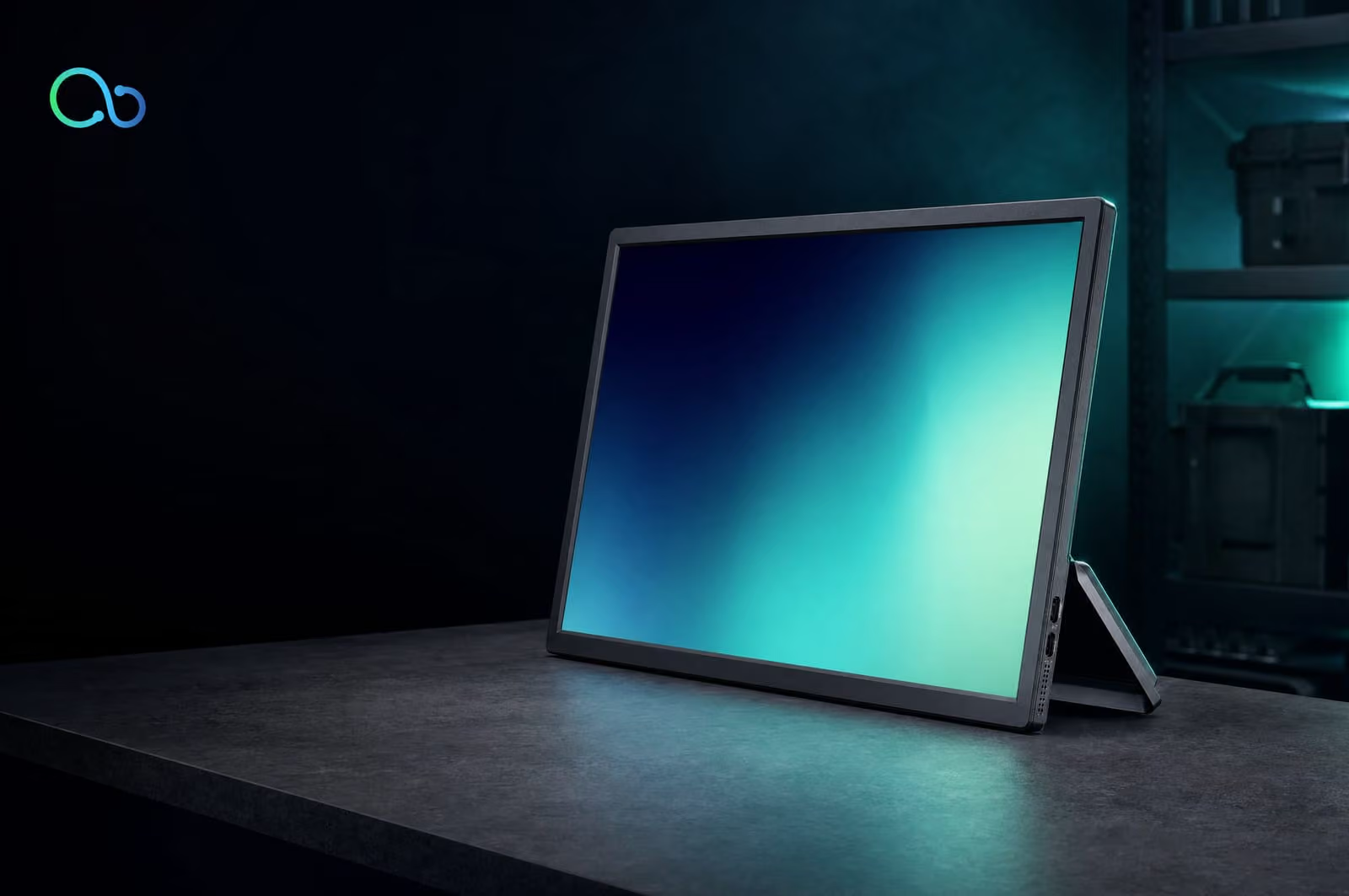
Define core monitor specifications for enterprise deployments
Enterprise workstations require displays that meet consistent visual performance and reliability across large numbers of seats. Selecting a baseline set of specifications prevents mismatched image quality and reduces support overhead when devices are deployed in bulk.
- Resolution – Minimum 1920 × 1080 (Full HD) for standard desktops; 2560 × 1440 (QHD) or 3840 × 2160 (4K) for design, CAD, or data‑intensive tasks. Choose a resolution that matches the native pixel density of the intended screen size to avoid scaling artifacts.
- Aspect ratio – 16:9 is the most common, but 16:10 provides extra vertical space for document work and should be considered for productivity‑focused environments.
- Panel technology – IPS panels deliver wide viewing angles (≥170°) and consistent color reproduction, essential for collaborative spaces. VA panels offer higher contrast ratios and are suitable for control rooms where deep blacks matter. TN panels are rarely justified in enterprise due to limited color accuracy.
- Refresh rate – 60 Hz is sufficient for most office applications. Higher rates (75 Hz or 144 Hz) are only needed for graphics‑intensive or simulation workloads.
- Brightness – 250–350 cd/m² meets typical office lighting; higher values are required for bright ambient environments.
- Contrast ratio – A static contrast of 1000:1 or better ensures readable text in mixed‑light conditions.
- Color gamut – sRGB coverage of 100 % is the minimum; Adobe RGB or DCI‑P3 coverage may be required for media creation teams.
- Response time – 5 ms GTG or faster prevents ghosting in fast‑moving content; lower values are not a priority for static office work.
All monitors listed in the CoreRex catalog include the standard 12‑month manufacturer warranty and are eligible for a 14‑day return window. For a full product range, see the computer display monitors category.
Evaluate connectivity and mounting options for standardized installations
Video inputs and integrated features
Enterprise monitors should support at least one DisplayPort 1.4 connector to carry 4K @ 60 Hz or 8K @ 30 Hz with DSC. HDMI 2.1 is useful for devices that lack DisplayPort, providing 4K @ 120 Hz and HDR support. USB‑C with DisplayPort Alt Mode adds a single‑cable solution for modern laptops: video, data, audio, and up to 90 W power delivery. When selecting a model, verify the USB‑C PD rating matches the intended host; a 65 W profile is common for thin clients, while 90 W covers most workstations.
A built‑in USB hub simplifies desk clutter. Look for at least four downstream USB 3.2 Gen 1 ports and one upstream USB‑C port for hub connection. Integrated audio jacks (3.5 mm) allow speaker or headset use without extra cables. If the monitor supplies power via USB‑C, ensure the hub’s upstream connection also carries PD to avoid a separate power adapter.
Mounting and cable management
Standard VESA patterns for enterprise units are 100 mm × 100 mm or 200 mm × 200 mm. Confirm the monitor’s mounting holes match the chosen arm or rack bracket. Weight limits matter: most 27‑inch panels stay under 12 kg, but larger 32‑inch models can exceed 15 kg, requiring a heavy‑duty arm.
Cable management should include a rear‑panel grommet or clip system to route DisplayPort, HDMI, USB‑C, and power cords neatly. Some frames offer a built‑in cable channel that aligns with the VESA mount, keeping cables out of the work area. When planning rack installations, verify that the monitor’s depth (typically 250‑300 mm) fits within the rack’s clearance and that the power cord length meets the rack’s rear power strip layout.
For warranty details, see the 12‑month manufacturer warranty. Return policy information is available under returns.

Compare panel types and ergonomics across common enterprise use cases
| Panel type | Viewing angle (horizontal × vertical) | Color accuracy (ΔE) | Typical ergonomic adjustments |
|---|---|---|---|
| IPS | 178° × 178° | ≤ 2 ΔE (sRGB 99 %) | Tilt ± 30°, swivel ± 45°, height ± 150 mm, pivot 90° |
| VA | 170° × 160° | ≤ 3 ΔE (sRGB 95 %) | Tilt ± 20°, swivel ± 30°, height ± 120 mm, pivot optional |
| TN | 160° × 150° | ≤ 5 ΔE (sRGB 90 %) | Tilt ± 15°, swivel ± 20°, height ± 100 mm, no pivot |
Control rooms – Continuous monitoring demands consistent contrast and deep blacks. VA panels provide the highest native contrast ratios, which helps distinguish subtle changes in video feeds. The limited swivel range is acceptable because monitors are often wall‑mounted or placed on fixed stands. Height adjustment is useful for aligning with operator chairs; pivot is rarely required.
Admin workstations – Data entry and document review benefit from wide viewing angles and accurate colors. IPS panels deliver the best color fidelity and the broadest tilt/swivel/height range, reducing neck strain during long sessions. Pivot support allows portrait orientation for spreadsheets or code editors.
Conference suites – Presentations may involve multiple participants viewing the screen from different positions. IPS panels again give the most uniform image across wide angles, minimizing color shift for side‑seat viewers. Height and tilt adjustments accommodate varying table heights and projector‑screen alignments. If cost constraints dominate, a VA panel can be acceptable when contrast is prioritized over color precision.
Select the panel that matches the primary visual requirement of each environment while ensuring the stand or VESA mount supports the listed adjustments. For a full list of compatible models, see the computer display monitors catalog.
Plan for multi‑monitor configurations and KVM integration
Sizing GPU outputs
Enterprise workstations and servers typically expose DisplayPort 1.4, HDMI 2.0, or USB‑C DP Alt Mode. Each DisplayPort stream can carry up to 8 K @ 60 Hz or 4 K @ 120 Hz, which is sufficient for most dual‑monitor setups. For triple‑monitor layouts, verify that the GPU provides at least three independent outputs; many mid‑range cards combine two monitors on a single DP MST hub, reducing bandwidth per stream. When using a workstation‑class GPU, count the physical ports and confirm that the total pixel clock does not exceed the card’s rated maximum (e.g., 540 MHz for a typical Quadro‑class GPU).
Daisy‑chain capabilities
DisplayPort Multi‑Stream Transport (MST) enables daisy‑chaining without extra cables. A monitor must support DP 1.2 MST and provide an output port. The first monitor in the chain consumes the full bandwidth; subsequent monitors split the remaining bandwidth. For three 1080p@60 Hz displays, a single DP 1.2 chain is adequate. For three 4K@60 Hz screens, a DP 1.4 source with DSC (Display Stream Compression) is required, or each monitor must connect to a separate GPU output. Verify that the chosen monitors list “MST Hub” in their specifications and that the cable length stays within 3 m for reliable signal integrity.
KVM switch compatibility
Select a KVM that matches the monitor interface: DP‑KVMs support up to 4 K @ 60 Hz, while HDMI‑KVMs are limited to 4 K @ 30 Hz unless the unit advertises HDMI 2.0 support. For dual‑monitor KVMs, each channel must provide two video ports; triple‑monitor KVMs are less common and often require separate units per monitor. Ensure the KVM’s USB hub supplies enough downstream ports for keyboard, mouse, and optional USB‑C docking. Cable routing is simplified by using a single 1‑m DP cable from the GPU to the KVM, then short patch cables to each monitor.
All hardware referenced carries a 12‑month manufacturer warranty and is eligible for a 14‑day return window. For detailed procurement guidance, see the procurement checklist.
Create a procurement checklist and TCO considerations
Step‑by‑step checklist
- Define warranty scope – Verify that the monitor includes the standard 12‑month manufacturer warranty and note any optional extensions. Record the warranty claim process and required documentation.
- Support contract options – Identify whether on‑site service, remote diagnostics, or a break‑fix agreement is needed. Capture response time guarantees (e.g., 4‑hour onsite for critical workstations).
- Payment terms – Confirm that the purchase order will be settled on Net 30. Ensure the finance team has the PO number and vendor invoice ready for the 30‑day cycle.
- PO processing workflow – Align the PO approval hierarchy with the procurement system. Flag any required budget codes or cost‑center allocations before submission.
- Inventory receipt and testing – Upon delivery, perform visual inspection, verify model numbers, and run a functional test (brightness, contrast, pixel defect count). Log results in the asset register.
- Return policy compliance – Note the 14‑day return window and the procedure for initiating a return if the unit fails initial testing.
Total cost of ownership factors
- Energy consumption – Record the monitor’s typical power draw (W) at 100 % and at power‑save mode. Multiply by expected annual operating hours to estimate kWh usage.
- Lifecycle length – Plan for a replacement cycle based on panel degradation (usually 4–6 years for office‑grade LCDs). Include disposal or recycling fees in the cost model.
- Mounting and cabling – Add the cost of VESA‑compatible brackets, cable management, and any required adapters (DisplayPort to HDMI, USB‑C).
- Software licensing – If the monitor includes built‑in KVM or remote management, factor the licensing fee per unit.
Next step: Use the checklist to draft a purchase request in the procurement system and attach the detailed TCO spreadsheet before routing for approval. This ensures all warranty, support, and cost elements are captured up front.
Frequently asked questions
What resolution should I require for enterprise workstations?
For typical office tasks, 1920×1080 is sufficient, but 2560×1440 or 3840×2160 improves productivity for multi‑window workflows and detailed graphics.
Which panel type balances color accuracy and viewing angles?
IPS panels provide consistent colors and wide viewing angles, making them suitable for collaborative spaces and control rooms.
How many and what type of video inputs are needed?
Include at least one DisplayPort 1.4 and one HDMI 2.0 per monitor to support modern GPUs and docking stations; USB‑C with DP Alt‑Mode adds flexibility for laptops.
What mounting options simplify large‑scale deployments?
Choose VESA‑compatible monitors (100 mm or 200 mm) and pair them with standard wall or arm mounts to reduce desk clutter and enable uniform cable routing.